.png)

Why I Created CRI's Tactical Drone Academy

Updated: Mar 3
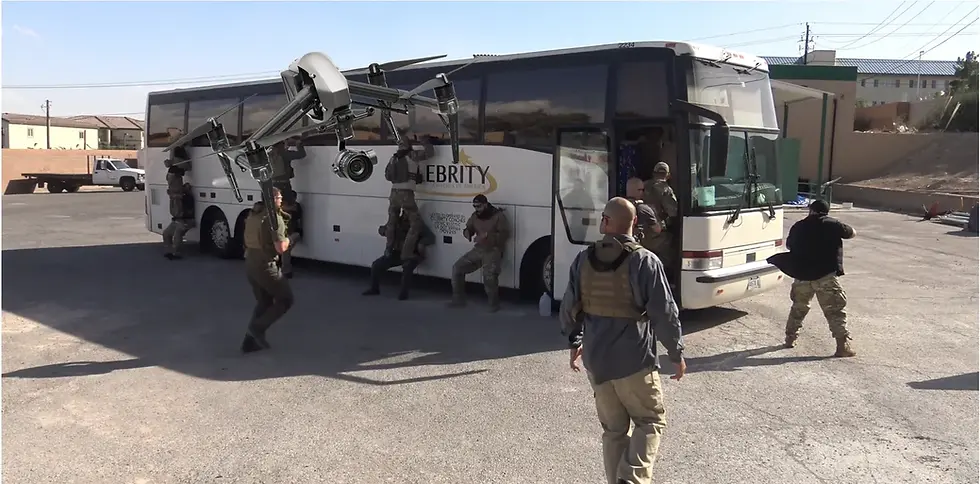
By Doron Benbenisty
Doron Benbenisty is the CEO of CRI Counter Terrorism Training School as well as the developer of CRI's Tactical Drone Academy (https://www.tacticaldroneacademy.com/), its courses and methodologies. Mr. Benbenisty is also an inventor of multiple drone and aviation technologies.
Since 2000, I have trained active-duty military personnel, including soldiers who fought in Iraq and Afghanistan, as well as law enforcement officers, SWAT units, and multiple three-letter
federal agencies. Throughout those decades of operational exposure, I witnessed firsthand the evolving nature of modern threats and the increasing risks faced by operators in the field.
In 2010, I realized something that very few people were thinking about at the time: drones had
the potential to dramatically enhance military and law enforcement operations.
The Early Vision
At that time, drone technology was still in its infancy. Commercial quadcopters were not yet
widely available, and the systems that existed were expensive and limited. Despite that, I
believed in the potential so strongly that I personally invested $30,000 in building our own UAV
platform. We conducted several test flights and made continuous improvements. However, the technology available at the time, combined with limited resources, made it difficult to fully develop the concept. Reluctantly, I decided to shelve the project and wait for the right technological moment.
The Turning Point: 2013
In 2013, everything changed.
Quadcopters began entering the commercial market, and prices started to drop significantly. For the first time, drones became accessible tools rather than experimental systems. I immediately recognized that the timing was finally right.
We began developing both lethal and less-than-lethal technological concepts for quadcopters.
But as we moved forward, I identified a much larger gap in the industry.
There was no structured methodology for using drones in security operations, law enforcement missions, or small military unit tactics.
Drones existed.
Pilots existed.
But doctrine did not.
Creating Tactical Drone Methodology
It became clear to me that drones were not just flying cameras. They were force multipliers.
They could:
Reduce operator exposure to risk
Provide real-time intelligence
Extend operational reach
Improve coordination
Enable safer mission planning
Increase mission success rates
Most importantly, I saw how drones could reduce risk to operators and enable more
operations with better outcomes. That realization became the foundation of what would later become the CRI Tactical Drone Academy.
Writing the First Comprehensive Tactical Drone Course
In 2021, I completed writing a full tactical drone course that addressed multiple industry
verticals, including:
Law enforcement
Military units
Federal agencies
Private security teams
Fire and medic rescue units
Maritime operations
Prison and correctional facilities
The course was not built around flying skills alone. It was built around operational integration and teaching professionals how to incorporate drones into real-world missions.
From that foundation, I developed sixteen Tactical Drone Pilot courses, each designed for specific operational environments and mission profiles.
Launching the First Tactical Drone Academy in the World
That journey — from early experimentation in 2010, to technology maturation in 2013, to
formalized doctrine in 2021 — ultimately led my company to launch the first Tactical Drone
Academy in the world.
The mission was simple:
Create structured methodology.
Reduce operational risk.
Enhance performance.
Save lives.
The CRI Tactical Drone Academy was born not from theory, but from decades of operational
experience, battlefield insight, and a clear understanding of where modern security forces, police and military defense were heading.
Drones are not gadgets.
They are tools of transformation.
And when used correctly, they change everything.


Comments