.png)

Counter-Sniper Exercise: What We Thought Was “Good Enough” — Wasn’t


By Doron Benbenisty
Doron Benbenisty is the CEO of CRI Counter Terrorism Training School as well as the developer of CRI's Tactical Drone Academy (https://www.tacticaldroneacademy.com/), its courses and methodologies. Mr. Benbenisty is also an inventor of multiple drone and aviation technologies.
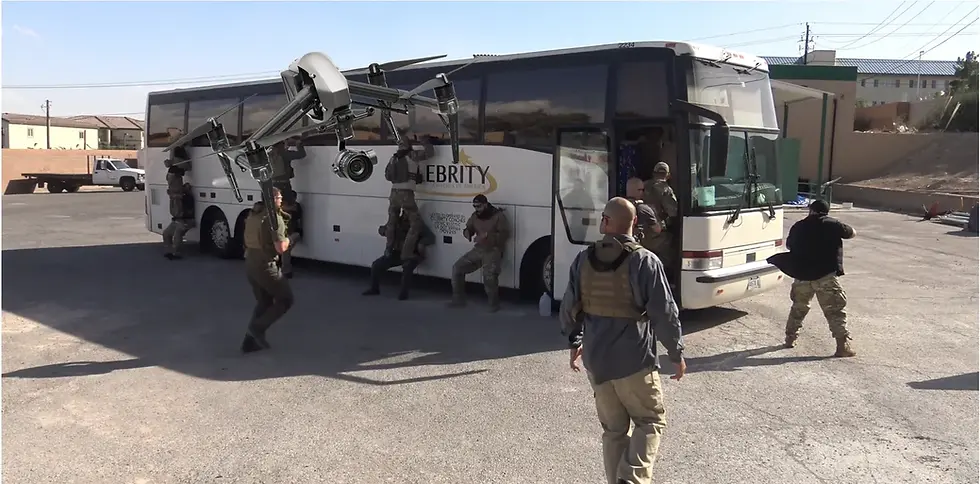
In one of our counter-sniper exercises at the Tactical Drone Academy, we ran a drill that completely changed the way our students think about drones, deployment time, and operational reality.
The mission was simple.
We positioned five role players acting as snipers. Each one was equipped with a less-lethal sniper platform and placed in concealed positions with a clear line of sight to a reactive target. Their goal was to sneak in, set up, and engage the target.
Our students’ goal was to detect them before they could “take the shot.”

Phase One: What We Thought Was Enough
At the beginning of the exercise, we deployed two platforms:
DJI Avata 1
DJI Avata 2
The pilots did a good job. They worked angles. They scanned rooftops. They checked tree lines. They investigated suspicious shapes and shadows.
They eventually located all five snipers.
But it took them FIFTEEN MINUTES.
In real-world terms, fifteen minutes is an eternity.
A trained sharpshooter needs seconds, not minutes.
Phase Two: The Eye-Opening Moment
We reset the scenario.
New role players. New sniper placements. Same objective.
This time, we launched a different drone:
DJI Phantom 3 Pro
What happened next shocked the students.
In less than one minute, all five snipers were identified.
Less than SIXTY SECONDS.
No confusion. No hesitation. Clear detection. Immediate situational awareness.
That was the moment their mindset shifted.
Not All Drones Are Equal
This exercise proved a critical lesson:
Not all drones are equal.
Some platforms are excellent for indoor operations. Some are agile and great for confined environments. Some are marketable and popular but limited in capability. And some are built for outdoor detection, overwatch, and real tactical scanning.
Sensor quality matters.
Camera resolution matters.
Stability matters.
Wind resistance matters.
Optics matter.
Deployment speed matters.
When counting a sniper, you do not get a second chance.
Real-World Tragedies and Hard Lessons
We have all seen what happens when a sharpshooter goes undetected.
The attempted assassination of President Trump. The tragic killing of Charlie Kirk.
In both cases, imagine if security forces had deployed the right aerial asset immediately.
Imagine if a drone had been launched the moment a suspicious individual was reported.
Imagine if rooftops, tree lines, elevated angles, and secondary firing positions had been scanned within seconds.
Early detection changes everything.
Counter-sniper operations are about time compression.
Who sees first. Who identifies first. Who reacts first.
A properly selected and properly deployed drone can shift that timeline dramatically.

Training Saves Lives If Done Correctly
This is why we train the way we do.
We do not assume. We test. We measure. We stress the system.
The first phase of our exercise showed that “having a drone” is not enough.
The second phase proved that having the correct drone , and knowing how to deploy it, can revolutionize counter-sniper methodology.
Drones provide:
A bird’s-eye view
Rapid overwatch
Immediate scanning of high ground
Real-time intelligence
Threat confirmation before exposure
Counter-sniper operations have traditionally relied on ground teams, optics, and reaction units. Drones add a new layer, speed and vertical dominance.
That vertical dominance can mean the difference between an attempt and a prevention.
Between injury and safety.
Between tragedy and survival.
The Bottom Line
Technology alone does not save lives.
Training does.
But training must be realistic. It must test assumptions. It must compare tools under pressure. It must expose weaknesses before the enemy does.
This counter-sniper exercise was not just a drill.
It was proof.
Proof that the right drone, in the right hands, deployed within seconds, can change the outcome of an attack.
This is how drones revolutionize counter-sniper methodologies.
And this is why we continue to train, refine, and push the limits, because when implemented correctly, training saves lives.

Comments